By David James · November 2026
Short answer: for most outdoor synthetic tracks, use 1/4″ (about 6mm) pyramid pins. Indoor tracks and some high school meets only allow 3/16″ (5mm) or 1/8″ (3mm) pins, and cross country and grass tracks call for longer pins. The rule that beats every chart is the one in your meet information, so always check it before race day.
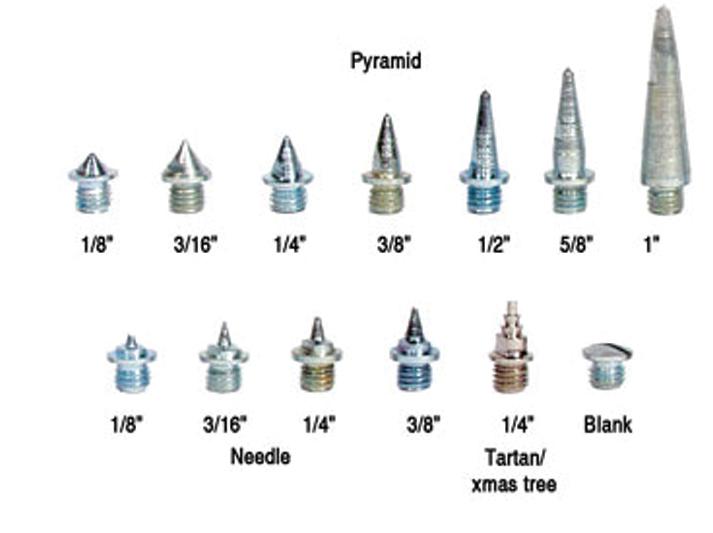
Spike pin size chart
| Pin length | Metric (approx.) | Typical use |
|---|---|---|
| 1/8″ | 3mm | Strict indoor tracks and venues that limit pin length |
| 3/16″ | 5mm | Many indoor tracks and some high school meets; distance races on some surfaces |
| 1/4″ | 6mm | The standard for outdoor synthetic tracks, sprints to distance |
| 3/8″ | 9–9.5mm | High jump and javelin (where allowed), grass tracks and dry cross country |
| 1/2″ | 13mm | Soft or wet cross country courses (never on a synthetic track) |
| 5/8″ | 16mm | Very muddy cross country |
Note that a 3/8″ pin measures about 9.5mm, which is slightly longer than the 9mm World Athletics limit for most events. If you compete under World Athletics rules, look for metric 9mm pins instead.
What the rules say
World Athletics. Under international rules, spikes can project no more than 9mm from the sole, except in the high jump and javelin, where up to 12mm is allowed (SATRA summary of the rules).
Venues are usually stricter. Track owners set their own limits to protect the surface. For example, the Australian Institute of Sport limits spikes on its Canberra track to 7mm (AIS spike usage), and Athletics Auckland's championships at Mt Smart Stadium allowed a maximum of 6mm, or 9mm in the high jump and javelin (technical regulations).
High school and junior meets. Rules vary by state and association. Some US state meets only allow pyramid pins up to 3/16″ and ban needles (South Dakota example). Junior competitions often have their own rules, including age limits on wearing spikes at all.
Pin shapes: pyramid, needle, Christmas tree
- Pyramid. A tapered, pointed pin that grips without tearing the track. It's the default for track and the one almost every venue allows. If in doubt, use pyramids.
- Needle. A thin, sharp pin that digs in. It grips well on grass, dirt and older surfaces, but many synthetic tracks ban needles because they can cut the surface.
- Christmas tree (compression). A blunt, stepped pin that presses the track down rather than piercing it. Some venues with Mondo surfaces recommend them, while others ban them, so check first.
- Blanks. Flat screws that fill empty spike holes so the threads don't fill with dirt or get damaged.
Steel or aluminium? Steel pins are cheap and durable. Aluminium and ceramic-tipped pins are lighter, and some tracks only allow them. For example, the Lee Valley track in London permits 5mm and 7mm Omni-Lite pyramid or Christmas tree pins but not steel pyramids (Neuff).
Which pins for which event?
| Event | Usual pins |
|---|---|
| Sprints and hurdles (outdoor) | 1/4″ pyramid |
| Sprints and hurdles (indoor) | 3/16″ or 1/8″ pyramid, as the venue allows |
| 800m to 10,000m | 1/4″ or 3/16″ pyramid |
| Long jump, triple jump, pole vault | 1/4″ pyramid |
| High jump and javelin | 1/4″, or up to 9mm where the venue allows (12mm under World Athletics rules) |
| Cross country | 1/4″ when dry, 1/2″ or 5/8″ when wet or muddy |
| Grass tracks (e.g. school carnivals) | Longer pins such as 3/8″ grip better on grass; check the carnival rules |
How to change spike pins
- Fit a spike wrench over the old pin and turn it anticlockwise to remove it.
- Check the thread in the plate is clean. A little dirt can stop the new pin seating properly.
- Screw the new pin in by hand first to avoid cross-threading.
- Finish with the wrench until it's snug. Don't overtighten, as stripped threads are hard to fix.
- Fill any unused holes with blanks.
What to buy
Prices are from VS Athletics on 1 November 2026 (USD) and change often.
| Item | Why | Price (USD) |
|---|---|---|
| Steel replacement spikes (bag of 100) | Every common length in pyramid, plus needles, Christmas trees and blanks | $14 (1/2″ and 5/8″ $24.95) |
| VS Hex Spikes | 1/8″ to 3/8″ pyramids | $14.95 |
| 1/4″ aluminium pyramid spikes | Lighter coloured pins for outdoor racing | $18 |
| 3/16″ aluminium pyramid spikes | Shorter pins for indoor or strict venues | $18 |
| T-handle spike wrench | Easy grip for stubborn pins | $5.95 |
| Ratchet spike wrench | The fastest way to swap a full set | $8 |
FAQs
What size spikes should I use for sprinting?
1/4″ pyramids on most outdoor tracks, and 3/16″ or 1/8″ indoors. Check the meet rules, because some venues set a shorter limit.
Are longer pins faster?
No. On a synthetic track a 1/4″ pyramid already grips fully. Longer pins add weight and can catch the surface, and they're often not allowed.
Can I use 1/4″ pins indoors?
Sometimes. Many indoor venues allow up to about 1/4″, but some require shorter pins. See our indoor track spikes guide.
How often should I replace spike pins?
When the points are visibly blunt or rounded, or a pin keeps working loose. Sprinters who train in spikes often need a new set every season.
Do spikes come with pins?
Most spikes with removable pins come with a set of standard pyramids and a small wrench. Some distance spikes have fixed pins that can't be changed.
Keep reading
About the author: David James is a former high-school and semi-professional track and field athlete who competed at national level in Australia and the UK.
Affiliate disclosure: Fast Running Club may earn a commission when you buy through links on this page, at no extra cost to you.
Newsletter
Get one useful session every week
A practical workout, a technique cue and the guides worth reading next. Free, and you can unsubscribe at any time.