By David James · November 2026
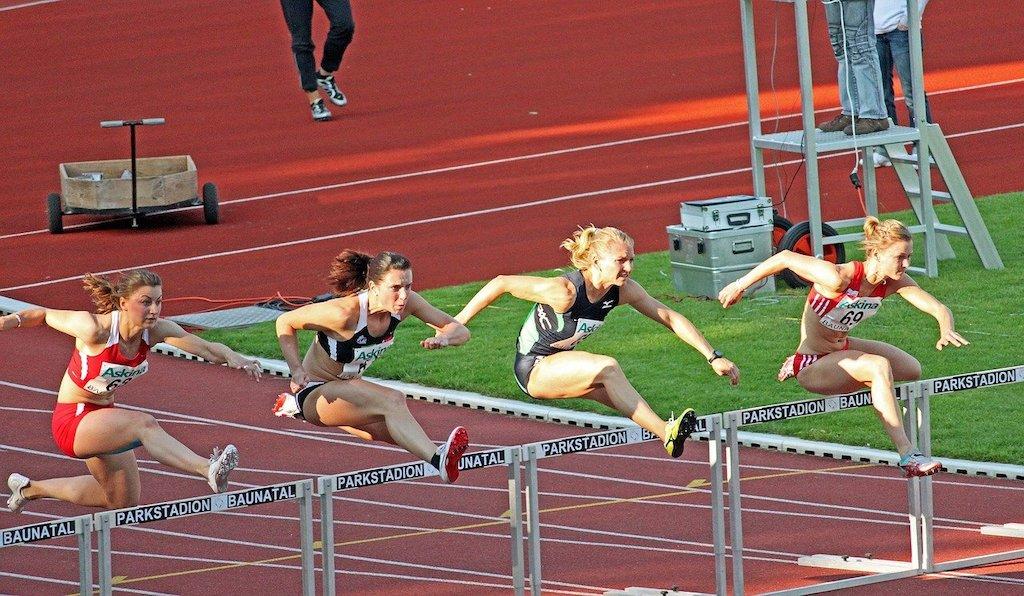
Hurdle heights and spacings depend on your age, your sex and where you compete. A US high school boy runs the 110m hurdles over 39-inch hurdles. An English Year 9 boy runs 80m over 84cm hurdles. An Australian under-15 runs 300m over 76cm hurdles. This guide collects the official specifications in one place, so you can set up a session or check a meet correctly.
The five standard hurdle heights
Most competition hurdles adjust to five heights. In the US they're known by inches:
| Height | Metric | Used for (examples) |
|---|---|---|
| 30 inches | 76.2cm | Women's 400m hurdles, US high school girls' 300m hurdles, many youth races |
| 33 inches | 83.8cm | Women's 100m hurdles, US high school girls' 100m hurdles |
| 36 inches | 91.4cm | Men's 400m hurdles, US high school boys' 300m hurdles |
| 39 inches | 99.1cm | US high school boys' 110m hurdles, U20 men's 110m hurdles |
| 42 inches | 106.7cm | Senior men's 110m hurdles (college and international) |
Standard races have 10 hurdles. The exceptions are shortened races, such as the 300m hurdles (8 hurdles in US high schools, 7 in Australia and the UK) and indoor 55m and 60m hurdles (5).
Senior (World Athletics) specifications
| Event | Height | Start to 1st hurdle | Between hurdles | Last hurdle to finish |
|---|---|---|---|---|
| Men's 110m hurdles | 106.7cm (42″) | 13.72m | 9.14m | 14.02m |
| Women's 100m hurdles | 83.8cm (33″) | 13.00m | 8.50m | 10.50m |
| Men's 400m hurdles | 91.4cm (36″) | 45m | 35m | 40m |
| Women's 400m hurdles | 76.2cm (30″) | 45m | 35m | 40m |
Indoors, the 60m hurdles keeps the outdoor height, approach and spacing but uses only 5 hurdles. For men, that leaves 9.72m from the last hurdle to the finish.
US high school and middle school hurdles
| Event | Hurdles | Height | To 1st | Between | To finish |
|---|---|---|---|---|---|
| HS boys' 110m hurdles | 10 | 39″ | 13.72m | 9.14m | 14.02m |
| HS girls' 100m hurdles | 10 | 33″ | 13m | 8.5m | 10.5m |
| HS boys' 300m hurdles | 8 | 36″ | 45m | 35m | 10m |
| HS girls' 300m hurdles | 8 | 30″ | 45m | 35m | 10m |
| Junior high girls' 100m hurdles | 10 | 30″ | 13m | 8.5m | 10.5m |
| Junior high 200m hurdles | 5 | 30″ | 20m | 35m | 40m |
Source: NFHS rules as adopted by the Texas UIL. Some states, such as California, Minnesota and Pennsylvania, run the 300m hurdles instead of the 400m hurdles. Middle school rules vary by state and league, so check your meet information. In Kentucky, for example, middle school boys and girls now both run the 100m hurdles at 8.5m spacing.
Indoor high school hurdles
- 55m hurdles (boys): 5 hurdles at 39″, 13.72m to the first, 9.14m between, 4.72m to the finish.
- 60m hurdles (boys): 5 hurdles at 39″, same spacing, 9.72m to the finish.
- Girls: 33″ hurdles, 13m to the first and 8.5m between.
English Schools (ESAA) hurdles
| Age group | Boys | Girls |
|---|---|---|
| Junior (U15, Year 9) | 80m hurdles | 75m hurdles |
| Intermediate (U17, Years 10–11) | 100m hurdles at 91.4cm (13m approach, 8.5m between, 10.5m run-in); 400m hurdles | 80m, 8 hurdles at 76.2cm (12m, 8m, 12m); 300m hurdles at 76cm |
| Senior (U19, Years 12–13) | 110m hurdles at 99cm (13.72m, 9.14m, 14.02m); 400m hurdles at 91.4cm | 100m hurdles at 84cm (13m, 8.5m, 10.5m); 400m hurdles |
For Years 7 and 8, the ESAA offers lower options. The 70m hurdles has 8 hurdles at 68cm or 76cm, with an 11m approach, 7m between and a 10m run-in. The 75m hurdles has 8 hurdles at 68cm or 76cm, with an 11.5m approach, 7.5m between and an 11m run-in. The ESAA's advice is to start young athletes on low, short spacings, so they can run a rhythmic three-stride pattern before moving up.
Australian Little Athletics long hurdles
| Age group | Race | Hurdles | Height | To 1st | Between | To finish |
|---|---|---|---|---|---|---|
| U14 | 200m | 5 | 76cm | 20m | 35m | 40m |
| U15–U17 | 300m | 7 | 76cm | 50m | 35m | 40m |
Mini hurdles are required for the U6 to U8 groups. Sprint hurdle specifications change by age group, so check Little Athletics Australia's current specification sheet before a session.
Finding the right marks on the track
Tracks have coloured marks for each race, but the colours aren't the same everywhere. Check the key painted near the start, or ask the track manager. At an unfamiliar track, measure from the start line once to confirm.
Setting up for training
- Learning? Lower the hurdles and shorten the spacing so you can keep a three-step rhythm. See how to 3-step the hurdles.
- Use the right counterweights. Competition hurdles have adjustable weights so they tip over with the correct force. Move the weights when you change the height.
- Face them the right way. The feet should point towards you as you approach, so the hurdle tips forward if you hit it.
- Need practice hurdles? See our guide to the best practice hurdles.
FAQs
How high are high school hurdles?
In the US, high school boys run the 110m hurdles over 39″ and the 300m hurdles over 36″. Girls run 33″ for the 100m hurdles and 30″ for the 300m hurdles.
How far apart are hurdles?
The gap is 9.14m in the men's and boys' 110m hurdles and 8.5m in the 100m hurdles. In all long hurdles races (200m, 300m and 400m), it's 35m.
Why do men run 110m and women 100m?
Both races have 10 hurdles, but the men's hurdles are higher and further apart, so the race is longer.
Sources
- NFHS rule adoptions: Texas UIL hurdle specifications
- ESAA Standard Tables 2025 (Year 7 and 8 hurdle specifications)
- Little Athletics Australia: Hurdle Specifications
- KTCCCA: middle school hurdle spacing update
- Wikipedia: Hurdling
Keep reading
About the author: David James is a former high-school and semi-professional track and field athlete who competed at national level in Australia and the UK.
Newsletter
Get one useful session every week
A practical workout, a technique cue and the guides worth reading next. Free, and you can unsubscribe at any time.